Sunday, April 23, 2017

Spring has finally come to Aizu


This past weekend, there was a massive 花見祭 (hanami matsuri, or flower viewing festival) on the grounds at Tsuruga Castle in the city center. For those of you who don't know what hanami is, it's essentially sitting on a tarp under a bunch of blooming cherry blossom trees, eating snacks and getting drunk with your family and/or friends. Last year, I didn't go to one because I was still new to Japan (and still without a car). This year, as if to make up for last year, I was invited to two. So here's a recap of them both:

DAY 1: WIND ENSEMBLE HANAMI

The University's wind ensemble was holding a hanami for all members to attend on Saturday. I took Tackawanna to the usual coin washing place in the southern portion of the city, then turned around and headed back towards the castle. It was the late morning, and traffic was especially starting to pick up. My intended destination was a coin parking lot to the immediate west of the viewing grounds, which normally serves as a visitor parking lot for the castle. Things looked a little bleak as I passed full parking lots and a message came in from my friends saying that they could not guarantee a parking space for me. Regardless, I turned onto the narrow one-way street, crowded with people, leading to the parking lot.


I managed to actually get a space in that lot. As it had turned out, the lot was full, but it was constantly letting cars in and out at that limit, to the point where the sign that said "full lot" and "spaces available" was constantly toggling. I parked in the lot and made the short walk to the flower viewing area to join my friends, who had started to arrive one by one. Our club president had just turned 20, which is the age of majority in Japan, so he was obviously celebrating with a few different drinks, including a Bacardi mojito and chardonnay in a can. Yes, you read the latter part correctly.


わんわん


Instrumentation (L to R): French horn, alto sax, percussion, alto sax

Instrumentation (L to R): clarinet, trumpet, percussion, string bass, French horn

Instrumentation (L to R): tuba (!!!!!!!), trombone

While we were sitting together, I remembered that I had not yet been inside the castle yet since I came to Aizu. General admission was 510 yen, but thanks to my international student museum pass provided by the University (which made my friends rather envious), I was granted free entry. Photos weren't allowed in the castle, with the exception of the observation deck, which was where I put my plan into place. After I got to the top, I found the spot where my friends were waiting and signaled out to them. Some of them responded, and I managed to snatch a picture of them from the observation deck.


We parted ways at around 1500 hrs, taking our own tarp and replacing it with another group's, to whom we promised to save them a space. (The area was rather crowded, and the amount of people increased as the day went on.)


DAY 2: STRAIGHT ARROW MOTORS x 9 NINE HANAMI

Saitou-san was holding a joint hanami on Sunday between the two businesses he has ownership in. (The other shop, 9 NINE, is a custom bicycle shop with a store right on the Chuo-dori.) That started later in the afternoon, which gave me enough time to make some food. (There was no participation fee, but patrons were expected to bring their own food to share.) I made some jalapeno hamburger "sliders" (still no hamburger buns available for sale in Aizu) to distribute at the hanami in the afternoon, then packed the car and headed out again.


I managed to park again in the same lot. By the time I'd arrived, the hanami was already underway. There were slightly less people in the area compared to yesterday. I distributed my sliders, which received critical acclaim, and tried some of the other food there, including a yakitori platter and an onigiri with grilled meat (wait, those actually exist???). We took some time to visit one of Saitou-san's friends putting on a traditional taiko performance, including a dancing session that they'd repeatedly tried to drag me into and that I'd repeatedly excused myself from.


The late afternoon turned into the early evening, and as everyone started transitioning between the tarp and the steep incline next to us, a hanami party happening right next to us got a little roudy. Saitou-san told me that they were a "small gang"; not affiliated with any larger organization, but had the fashion statement to suggest that they were more than just friends. Somewhere along the 2L cans of Asahi and sake, a guy ended up getting blackout drunk, in a method similar to what happened to me in December, minus the vomiting. His friends were trying to keep him conscious by yelling and slapping his face, which led to a plenty awkward situation of other hanami patrons to just stare straight ahead and say absolutely nothing.

Saitou-san on the right


I parted ways shortly before 1800 hrs. Saitou-san and a few others reduced their tarp footprint and stuck around to keep drinking. The lights surrounding the trees turned on automatically. Tomorrow, they said, the cherry blossoms would start shedding from the trees. Summer would be coming soon, given how late the festival was this year.

The weather was absolutely perfect, and I had Tackawanna's top down the whole weekend. I love the warmer weather, and hopefully I'll be able to enjoy it more on the weekends this year instead of staying inside. Next weekend, I'm meeting Saitou-san again. It's his yearly group trip to Costco. I'm so excited for it; needless to say, Tackawanna's true storage capacity will be tested.

-wp

Friday, April 21, 2017

Getting your Japanese driver's license in Fukushima (2016/2017 edition)

This blog post is for all the people out there who are currently in or are planning to move to Fukushima Prefecture in the immediate future. Fukushima, unlike Tokyo, is more mountainous and spread out, and even if you live in a densely populated city like Koriyama, it would be a very good idea for you to have a car, or, at the very least, a driver's license. Getting one is easy if you're from almost any [western] European country, Canada, Australia, or New Zealand. But this blog post is not for you. It's for the people from the other countries, including, unfortunately, America.
For those of you who can easily convert, there's no walkthrough needed. Book an appointment at either the test center in Fukushima City or Koriyama and take with you:
  • a Japanese[-speaking] friend
  • your current license and a JAF translation of it
  • older licenses if you've held onto them
  • a 30 x 24 mm photo of yourself (go to the 7-11; 200 yen gets you six of them)
  • a residence certificate
  • your resident card
  • your passport
It's that easy. For everyone else, there's additional testing required.

(This is a side note to any American readers planning to move here, particularly those who are living in the DC Metro area. Move to Maryland. They're the only US state as of this post with a reciprocal driving agreement with Japan. If you're there for at least three months, and can prove your previous driving history (e.g. saving old licenses), then you get to do the easy conversion process. Trust me, you want to do this.)

(UPDATE, 5.1.2017: Washington state residents, I have good news for you.)

I wrote a series blog posts reflecting on my overall experience with the conversion process. You can read them here: take 1, take 2, take 3, take 4, take 5, take 5.5, and take 6. These are my own personal experiences and may not apply to you, depending on what day you go and who's your proctor. For a more detailed walkthrough of the course, you should read yesicanusechopsticks's post from 2002. It's the same course. There's also a map layout that they give you at the test center; an annotated photo is in one of my posts.

Other than that, here's a list of very important pointers that you should observe:
  • Do not wait to do this. From the day I booked the appointment to the day I passed, it took me three months. If you haven't come to the country yet, get your IDP to take effect the day before you land here. That'll give you the full year, but that still gives you no excuse to wait. Plus, when I called for an appointment in July, the first opening was in September. So I'll say this again for effect: do not wait to do this.
  • The longer conversion process is only available in Fukushima City. Sorry, Aizu and Iwaki, but the center in Koriyama doesn't do the longer conversion process. You'll have to hitch a ride if you don't have a car.
  • It takes time to get to the test center. By car, from northern Aizuwakamatsu, it's an hour and a half one way on National Route 115. Don't bother with the expressways; in my case, you pay 1750 yen from there one way to shave off 10 minutes.
  • Between your travel time, waiting to take the test, and waiting for the test results, this will consume your business day. (If you aren't going by car, it will consume your whole day, as the train and bus schedules are spread out.)
  • Take the friend for your first trip to get the paperwork out of the way. No one at the test center speaks any English. For subsequent visits, if you know some basic Japanese like I do, you'll manage on your own. Don't be afraid to ask them for clarifications if you are confused about language or concepts, but also don't be surprised if they make it even more confusing.
  • Pick a transmission. If you don't know how to drive a manual transmission vehicle and don't wish to learn, stick with the automatic test. But be warned: you are limited to only automatic vehicles. If you drive a manual car with an automatic transmission, and you get stopped or in an accident, you're fucked. Like time in prison fucked. Be sure to tell the clerks which transmission you want to test on.
  • Book a lesson at a local driving school. Don't be a cheapskate about it. You don't have to go for full tuition; they can do individual lessons. Tell them what you're fucking up on and they'll give you some pointers and training to help you out. See part 5.5 for my experience with that.
  • The written test is annoying. You have the 10 questions and five minutes to answer them. The questions require you to think, too. See take 1 for an example. Don't take the written test lightly; I barely passed with seven out of ten right. I've also met a guy at the center who'd actually failed the written test, and he wasn't allowed to take the driving test until he passed the written one, which he had to come back for. (It'd actually be a good idea to get a copy of JAF's Rules of the Road and read it for the diagrams and whatnot.)
  • Go walk the course during lunch. Is it raining out and you don't have an umbrella with you? Buy one from the convenience store on the first floor and go anyways. Is it not your first time? Go walk it again. Also, if you're American and not used to measuring distance in metric units, actually measure how long 30 m is on that track. They give you a course map before your first attempt, as well as a bilingual packet containing some generic pointers for taking the test.
  • You will not pass the first time. That one guy online who says that he did was an outlier. It took me six times, and two other people I know also went six times (and they were on automatics). Those five prior times, every time I went, everyone who took the test that day, regardless of their age or nationality, failed. Even during my last time, I made some errors that would've gotten me failed any other day. So get used to the process of going back and forth to Fukushima City, because you will be doing it a lot.
  • Your course completion must be 100% perfect and without error. You are, to put it bluntly, the proctor's bitch. He can, and will, fail you for just about anything under the sun. Don't bother with trying to figure out the whole points system. I've already done it for you.
    • You took a turn or a curve (>15 km/h) too fast? 不合格。
    • Didn't turn on your blinker at approximately 30 meters from a turn? 不合格。
    • Got too close to a stop line? 不合格。
    • Didn't swerve to the curb/center line prior to taking the turn? 不合格。
    • Didn't "properly" check at every turn and maneuver? 不合格。
    • Didn't pump your brakes when slowing down and/or downshifting? 不合格。
    • Didn't stop directly at the pole at the end? 不合格。
    • Didn't check traffic before you got out of the car?  不合格。
  • Said proctor will also try to act as obtuse as possible, even to an insulting degree. I had one proctor who would give me three, and only three, pieces of feedback after completing the course. If there were four things, I'd find out the fourth the next time. Another tried to go behind my back and have my translator booking my appointments tell me a piece of feedback, despite me being in the same car with him and having already received feedback from him.
  • Either they will let you book your next attempt after your failure, or they'll ask you to have your translator book an appointment on your behalf. (It depends on when and whom the clerk is). And no, you can't book multiple tests at once. (I've asked.) When you go back for subsequent tests, be checked in, including completing all required paperwork (yes, you have to resubmit the same form every time), by 1130 hrs. The clerks disappear for lunch, and testing starts as soon as the break is over, so if you miss the cutoff time, you don't get to test that day.
And finally, one more piece of advice.
  • Your chances of passing on any given day are actually random.
Wanna know how I know this? Every time the first five times I went, they failed everybody there. Japanese and foreigners. On the sixth time I went, I made those two serious mistakes that would've failed me any other day. And remember Nautiyal? Well, if you've searched the Google already regarding the driving test at this particular driving center, you may have noticed this particular Blogger post from an expat couple posted about five years back. He made the exact same mistake at the bicycle marking that they did.

And he still passed.

Do not ask me how this whole fucked-up system works. I can't tell you, and when I tell this to other Japanese people, they are as confused as I am. I am 100% convinced after this entire debacle that the passage process is up to whatever mood that the chief at the driving center is currently in, and that if it wasn't universal for everyone testing that day before, it is now.

That's all the advice I can give. Of course, you can always take the Japanese route and go for full tuition at a driving school. That'll cost you around 25-30万円, and the written test is all in Japanese. But you're probably broke as you're reading this, so take this and all other advice with a grain of salt and try not to strangle the proctor.

Good luck, kid; you're actually gonna need it.

-wp

Travels with Tackawanna 13: the heart of Aizuwakamatsu

Last month, before leaving for Kyoto, I purchased an action camera. I'd always wanted a GoPro, because of its ruggedness and its ability to be mounted outside of a car. However, GoPros are notoriously expensive, even more so in Japan (anywhere up to a 30% increase over US prices). No way my broke grad school ass can afford one. But after some searching online, I found myself a new action camera. It's from a British company called Olfi. I watched a video comparison test online and found the Olfi to be on par, if not better, with one of the new Hero models. Therefore, I took the plunge and purchased a camera, a small accessory kit, and a handheld remote used to operate it from a distance.

However, this did not entirely complete the setup. I lacked two things: one was an actual mount to put on my car, which was not for sale on Olfi's website, and the other was an appropriate power cable that could run from out of my USB power adapter in Tackawanna, out the left window, under the left side of the hood, and out towards the front for the camera to stay connected to while driving. For the former, I discovered that the Olfi's mounts were actually cross-compatiable with GoPro's mounts. Therefore, I went to a local electronics store and purchased a GoPro suction cup mount for vehicles. For the latter, I purchased a three-pack of three-meter nylon-braided microUSB cables and some 3M special-purpose heat shielding tape. One night after dinner, I put on the new Dave Chappelle stand-up special on Netflix and sat at the dinner table wrapping the section of one of the cables under the hood with a solid layer of the heat-shielding tape.

Now, I have what I had originally wanted for Tackawanna; an action camera on an external mount that can be constantly powered from my car. And to top things off, even with the mount, and the extra cables, and the [rather pricey] tape, I STILL paid $100 less than buying the newest GoPro Hero Session. Needless to say, I'm very satisfied with my purchase. I've actually already used it for my last two posts. I'll still be holding onto the old dashcam, as that will be there for insurance purposes in the [hopefully non-existent] case when I'll need to prove what happened in an accident.

Last weekend, the weather in Aizu hit the low 70s, although there were still no cherry blossoms outside. I decided to enjoy the new weather and test my full setup for the first time. I drove directly from the University down Chuo and Shinmei-dori, aka National Route 118, before turning around at the Ashinomaki Onsen area and returning back to the University the same way.

Here, however, was where I ran into a problem with the camera itself. Ever since performing a firmware update on the camera, the remote stopped working, and the camera would cut off recording after 28 minutes (maximum file size). I will give Olfi some credit thanks to their tech support, because I was able to reset the remote pairing, as well as learn that my SD card apparently wasn't strong enough to maintain the transition between different video files. The camera doesn't come with a detailed manual, and online instructions are scarce and sparse, so take that as you will.

Because the video kept cutting out after that time, and the ride back towards the University was mostly stuck in traffic, I've cut the videos in both directions to end at the same arrival point: an intersection in the southern portion of the populated area of the city. So with the lack of cherry blossons and irregular edits in mind, please enjoy the beauty of this wonderful city in the midst of spring.


-wp

Hokuriku Roadster Meeting

It's springtime in Japan, and springtime means cherry blossoms. The southern portions of Japan started blooming at the start of the month. Aizu, however, didn't start blooming until this week, as we are further north.

Nagoya, however, was one of the blessed areas, and on a Miata-related Facebook group I'm a part of, my friend Matsuda-san, who I met in the flesh for the first time back in October, posted a photo of his Roadster underneath a row of blooming cherry blossom trees. Matsuda-san also dabbles in a bit of photography, and the picture turned out very nice. I left a comment stating how Aizu wasn't supposed to reach full bloom until the latter portion of the month. Matsuda-san liked my comment, and replied with an invitation. Not to Nagoya, but to Niigata Prefecture for a Roadster meeting that very weekend. With nothing else to do that Sunday, I decided to take the trip.


Everyone at the meet (Photo: Matsuda-san)

It was a three hour trip with two hours by expressway, first west on the Banetsu, then south on the Hokuriku Expressway. (It was about $40 going one way in tolls.) The meeting was in a village in the southern, mountainous portion of the city of Joetsu. Although I left with plenty of time to get there, I ended up having to take a detour, as the road that Google Maps chose for me was still closed for the season at the time. (Luckily, I was not the only person who made this mistake. When I got to the closed road, another Roadster owner was there similarly confused.)

I arrived at the event about half an hour late, just as they were finishing the opening meeting. After I finally registered, everyone dispersed and moved around the different cars, talking with each other about the various mods that they did on their cars. There was one event where they had a competition to see who could cook an oyster over an open flame the fastest just by using a fan. I didn't participate due to the oyster part; now if it was meat they were cooking, I'd be stepping over people just to get to the front.


Someone testing out a rim cleaning product on Matsuda-san's Roadster. Wish I'd gotten the name.


I also met lots of new people there. Among them were Fujimoto-san, an English linguistics professor at Kyoto University of Foreign Studies. (Small world, huh?) I also met Wakasa-san, the chief engineer for the ND Roadster's (the latest model) powertrain. The person I was most surprised to meet was Mizuouchi-san, the head of the Roadster Club of Japan (aka the Roadster owner association). He had come all the way from Tokyo just for the event. Even though this was a regional meeting, people came from as far away as Fukui Prefecture. There was a sleepover at the event location the night before, and Fujimoto-san told me that the party apparently lasted all night, with everyone getting totally plastered. If I didn't have plans that Saturday, I'm sure I would've been among those people.

Fujimoto-san on the left, rummaging for his business card (Photo: Matsuda-san)

Wakasa-san and I exchanging business cards (Photo: Matsuda-san)

I've started getting more comfortable with speaking in Japanese. Yes, it's still shit, but I at least have enough basic skills to [kinda] convey what I want to say. I ended up exchanging quite a few of my business cards with the other Roadster owners, which is a good thing because I ordered a hundred of them last year and only used less than 10 before that day. (I'm sure that I'll use many more at Karuizawa next month for the national meet.) In addition to the business cards, I got interviewed by the editor of the association's editor about Tackawanna. I told everyone about our history together; the mods I did, the trip the Hachinohe that went haywire, shipping the car home when I leave Japan, etc. If I end up in the magazine, I'll update the blog with another post, including a [shitty] translation.

Me talking with the editor (orange jacket). Noticing a pattern yet? (Photo: Matsuda-san)

At one point towards the end, we all sat down for a lecture from the chief engineer of the ND Roadster's development. He discussed the basic history of two-seater cars and how they came to the design that the Roadster is now world-renowned for. I couldn't understand most of the Japanese, but the chief engineer drew very excellent drawings on the whiteboard of various two and four-seater cars. I can see why they picked him as chief engineer; he seemed to know his shit.

Me shaking hands with the chief engineer

Following the lecture was a rock-paper-scissors event. I won some local instant ramen. For those curious as to how the game looked, I shot a video.


Lunch was curry, provided by the event, which was pretty good. After the meeting adjorned, Matsuda-san invited me and a few other Roadster owners to go out for soba. It was actually my first time having soba, so I was excited to go. Over dinner, we learned more about each other's backgrounds. For example, Matsuda-san told me that he worked at a metal recycling plant, which melted copper and other precious metals at high temperature for recasting. The soba restaurant was further south from the meeting event, but because it was next to the Joshin-etsu Expressway, the drive home took about the same amount of time as getting there. (Same price for the tolls, too. 痛い!)

Matsuda-san getting a convoy shot at the red light

Soba spread

With my time in Japan already halfway done, this year I plan to do more travelling on the weekends if I can. I also want to take a road trip this September, during summer vacation, to Hiroshima, to bring Tackawanna home, in a romantic sense. That's at least a 14-hour one-way trip with breaks. I've already learned my lesson for next time: don't go during a national holiday, when the auto repair shops are closed. That, and the major things that can go wrong have already been fixed.

Oh, and I took a decent dashcam footage last weekend during a beautiful day outside with my new action camera. A TWT post for that will come soon. But for now, here's some action camera footage of me travelling on the Banetsu ($40, and it was only one plane on that portion). 楽しんで見てくださ〜い。


-wp

Thursday, March 23, 2017

Review: 8th generation Daihatsu Hijet (w/ video!)

jay-dee-ehm

As I have said many times in the past, Tackawanna suffers from an unprofessional and [slightly] unseemly paint job, which included the hood of the car painted in black. Black hoods are a thing in car culture, because apparently that reduces the glare on the hood being reflected into the driver's eyes. I didn't mind the black hood, and thought that it looked actually cool. But then the winter came, and that's where the shitty paint job started showing its true colors. And by showing, I mean shedding the paint.

The plan was to paint only the hood by myself when it gets warmer, as I wouldn't be doing a total repaint job until Tackawanna is in the states with me. However, this did not sit well with home base, which was concerned that I'd be huffing the fumes and would kill myself, even with a respirator. I tried to assure her that I would take the proper steps, but this was countered with an offer to compensate me for having someone else repaint the hood for me. This ended the argument rather quickly.

I brought my car to Saitou-san, who said that he would have the hood repainted to match the rest of my car. (At this point, faded grey looks a LOT better than the current status of the hood, what with its bare metal being slowly exposed and all.) Like last time, when he gave me the Minica to drive around, he had another loaner lined up for me. He called it the "Super Minivan." At first, I was confused, as he had a giant black Toyota Voxy van with no plates on the lot being prepped for a customer. But then he brought me outside to the vehicle tucked in the corner of his small parking lot. It was a Daihatsu Hijet.


Ladies and gentlemen, I shit you not when I tell you that I spent the first mile driving home in straight up laughter. Despite what it is and its current condition, the car is an absolute blast to drive. I had plenty of fun just taking it around town for a spin. The van also sported a manual transmission, so I finally got to experience driving a manual kei car during my time in Japan.

I've always wanted a GoPro, but the price point, and subsequent mediocre quality, put me off from making the purchase. However, I did find a camera online called the one.five from a small British brand called Olfi. Even though I still had to go to the local electronics store and pick up a GoPro suction mount for a vehicle, I still saved over $100 compared to the cheapest new GoPro on the market today. I'm also quite happy with the image quality.

So for this post, instead of typing out my review, I'm doing things a bit differently. I've actually filmed it and am posting it right here for you all to see. As you can tell by the video, Clarkson, May, and Hammond aren't in danger of losing their spotlight. I'm usually camera shy and wary of public speaking, so I still have yet to get truly comfortable in filming myself while talking. However, I hope that I'll get better at this in the future, and maybe I'll take a friend so we can get action shots of the car. (I can say for certain that having a better camera helps!)


As an aside, I arrived in Japan exactly one year ago today. I can't believe that half of my time in Japan has already come and gone. I've got so much to do, and now I have less time to do it all. Hopefully I can put some more time into this blog, too. I've already got a few posts in my backlog that I have yet to type, but lately it's been a matter of laziness in typing them all out. Blog posts (or, at least mine) usually don't take 15 minutes to hack out.

Anyways, enjoy the video.

-wp

Saturday, March 11, 2017

Kyoto - Ultimate Trip Recap


Holy shit, I haven't updated this blog in nearly two months. Let's change that.

This morning I arrived back in Fukushima from a four-day expedition in Kyoto. The select few of you who read my blog probably recall back in October when a group of students from the Kyoto University of Foreign Studies (hereon called Kyoto Gaidai) came to play with us at our concert. This is because we have a sort of "sister" wind ensemble relationship (kind of like sister cities) with that universities wind ensemble. Every March, a few students from Aizu go down to Kyoto to visit the other group. I was one of them.


We ended up taking a night bus there and back, and we went this past Tuesday night. It was on a double decker bus, direct from Koriyama to Kyoto Station. The top floor was so small and narrow that even my Japanese friends were complaining. I ended up drifting off to sleep for about an hour at a time, randomly waking up at different parts of the evening to check our progress on Google Maps and shift in my seat in pain from the sore tailbone that I fell on in undergrad.


After we arrived at Kyoto Station on Wednesday morning, we passed some time at a cafe before meeting up with some of the students from Kyoto Gaidai to take us to where we'd be staying. Oono-san, one of the other students, and I would be staying in the west end of the city with one of the students from Kyoto Gaidai who came in October. As you may know, I have a hard time with name retention. However, much to my help and delight, I later found out that this student's actual nickname was, and this is true, "Jimmy." Jimmy lived right off the same bus line, right next to one of the many shrines that scatter the entire city of Kyoto.


We dropped off our stuff at Jimmy's apartment and then went to Kyoto Gaidai's main campus. There, we met the other students for an introduction meeting and a few games, with a brief break in the middle for some ramen at a nearby shop. Some of the conversations were native-level Japanese, so naturally I missed out on a few jokes, although I did have some moments to socialize, like when we played shiritori (しりとり), a Japanese word-guessing game where you have to give a word that starts with the last letter or character of the previous word. We did a few rounds using pictures, and then a few rounds using English. (I proofread the English versions, of course.)


Afterwards, we broke off into different groups for the day, and my group went to a nearby mall to shop and hang around. We then headed back to Jimmy's apartment for drinks (I didn't), and that's when I learned that Jimmy was a lightweight. He got so drunk that he actually got into bed and went to sleep, while everyone else was still in his room.


The next day, Thursday, was a sightseeing day. We all met up at Fushimi Inari-taisha (伏見稲荷大社), the shrine famous for the pathways lined with toori (鳥居). What you may not know is that each of these toori are paid for by various companies, whose names are written on the back of the toori that it paid for. The group that I was sightseeing with decided not to traverse the entire shrine, as that takes a good portion of the day, so we decided to go to other places in the city.


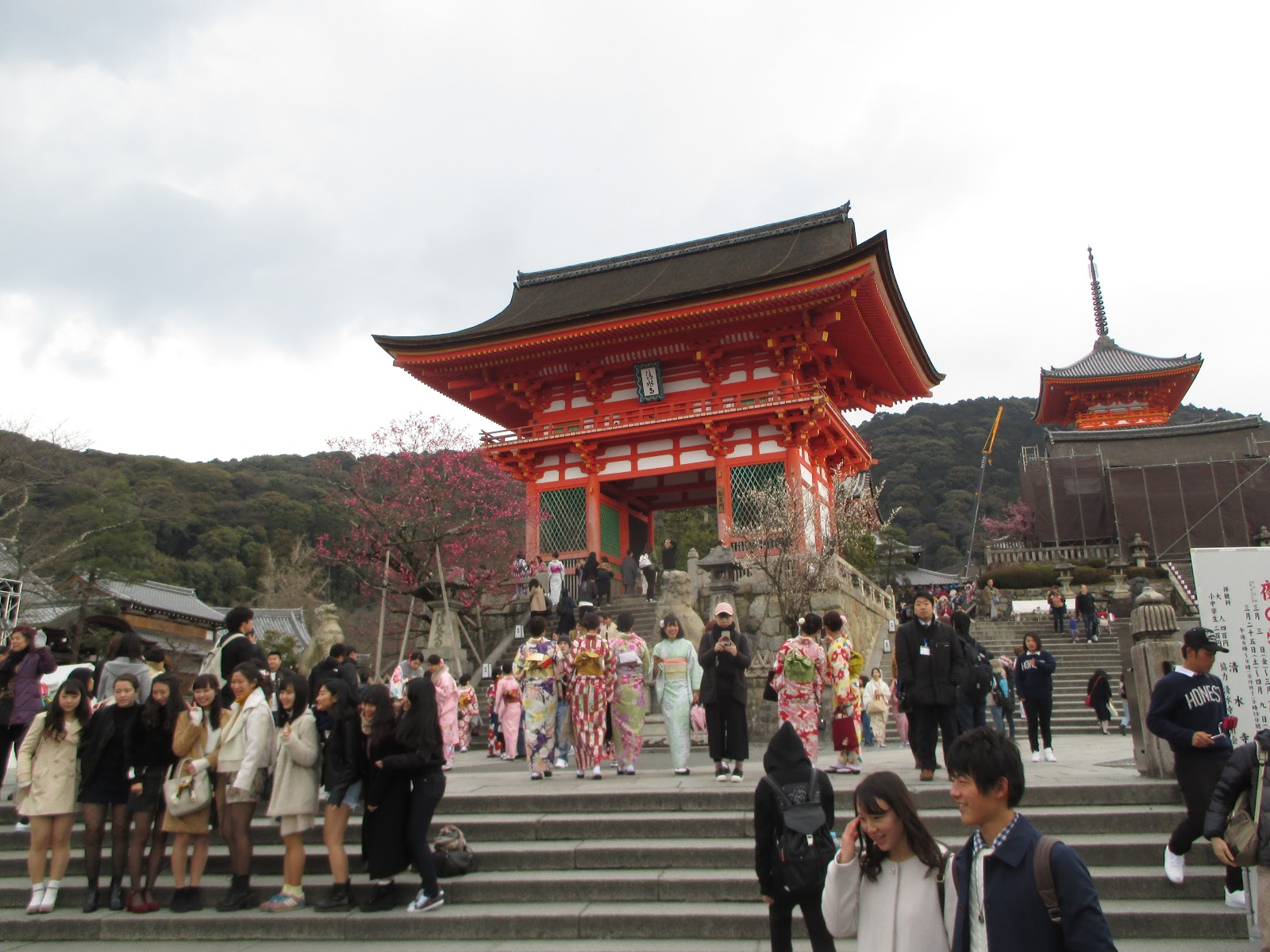
The next stop was Sanjusangen-dou (三十三間堂), which was a museum of Buddhist statues from the earlier part of the last millennium depicting the various gods worshipped in Japan. (No photos were allowed inside the hall.) Following there was Kiyomizu-dera (清水寺), where we got to see a lovely view of the city and wash our hands under a sacred waterfall.


We then spent some time afterwards walking around Nishiki Market, a series of covered side streets [that turn into actual streets after the shops close for the night] hosting all sorts of food shops, before heading to meet everyone else at a hole in the wall izakaya right next to the Rhino, the very same hotel that I stayed in when I first visited Kyoto two years prior. I was tired from walking around, so I ended up sleeping through dinner while everyone else was getting hammered. I wasn't the only one who fell asleep at the party; Jimmy also passed out from the liquor. We ended up having to wake him up to take us home while some of the others went out for karaoke.


But the evening was not over for Oono-san and I. We got back to Jimmy's apartment, only for there to be no power. The breaker was fine, he wasn't behind on his payments, and the support hotline was closed for the night. I had already dealt with sleeping on Jimmy's floor for one night, which was okay, but I didn't want to do it again in the dark with no power or heat. Therefore, I searched online for a hotel that would be able to take us in that late. Ironically, the closest one was the Rhino, which was back towards the city center. Oono-san called the hotel to confirm, and we parted ways and retraced our steps and checked into the hotel just in time. As it had turned out, the hotel was undergoing reservations the last time I had stayed there, and the results were fantastic. We had a nice corner room overlooking the city.


The next morning, Friday, was the actual practice between the two wind ensembles. Oono-san and I checked out and headed back to Kyoto Gaidai's campus. We were the first to arrive, only to find out that the starting time that was part of our original schedule was incorrect. We ended up hanging around for everyone, and we all got setup. Thankfully, Kyoto Gaidai had a Yamaha YBS-62 bari that I could use, so I didn't have to haul the one from Aizu. That horn had a darker sound with my mouthpiece attached, which I thought was pretty cool.


We started practice with sectionals, where we tuned and went over the two songs we would be playing. Taniguchi-san, who I first met in October, was there, and my Japanese was up to par for the practice time. We then broke off for lunch, which is a good time for me to share with you an awkward moment of cultural exchange.

SCENE: A giant lecture room at a university in Kyoto. Early afternoon. Students sit around in a large group of semi-groups eating packed and convenience store lunches.

Enter 大きと変な外国人 from stage right. He is wearing sunglasses and Bluetooth headphones, and carrying a plastic bag with McDonald's food. The other students do not mind him. 大きと変な外国人 takes out his lunch from the bag: a specialty burger, some chicken nuggets, and a drink. He eats one of the nuggets first before unwrapping his burger. The burger is a mess; the fast food worker put on too much sauce, and the bun and inside of the wrapper are soaked. 大きと変な外国人 lets out an audible grumble, then takes a bite out of the burger regardless.

At this point, the other students break from their conversations and phones and stare at 大きと変な外国人 as he is finishing his first bite. He notices their stares and suddenly gets slightly nervous. He swallows what's in his mouth.

大きと変な外国人: 「な、何?」

大野さん speaks for the rest of the group.

大野さん: 「いいえ、何でもない。」

大きと変な外国人 takes a second to process the situation, then shrugs and continues eating his lunch. The other students continue with their conversations and lunches.

END SCENE


Following lunch, we all set up for practice, going through both pieces section by section. The songs were Shiokaze-no-maachi (汐風のマーチ) and Copacabana. (To the dinosaurs that read this blog: yes, it's the Barry Manilow song.) We took a brief break after practice, and then we played both songs in their entirety. Jimmy recorded the audio for both, and I tried to get video on my Canon PowerShot. However, I only managed to get Copacabana; the other one did not save to my camera for some odd reason. The video should appear on our wind ensemble's Youtube account in the near future.


At this point, after a few photos, it was time to pack up and head next door for an afterparty. Everyone from Aizu gave remarks, including myself (mostly in English, but with some Japanese), and we helped ourselves to some free food. I got to properly socialize with Taniguchi-san, as well as Tanikawa-san, another saxophone player who did not come to Aizu in October but spoke English rather well. We received a small bag from Kyoto Gaidai with a very nice sweat towel, and took one last picture as a group before heading off to the train station to catch our bus.


I have been to Kyoto Station before, but I did not know that aside from the tracks and the bus stop, the entire facility was an architect's dream come to life. Among the many different shopping areas was a Macy's-like department store that went up ten floors, and I know this because I took an outside escalator to the top of the station, where we all got to see a good view of the city. It was a perfect moment to the end of a short but fantastic trip. I need to come back to Kyoto one more time before I leave Japan. Maybe next time I'll swing by Osaka afterwards, as it's a short distance away from Kyoto.


And finally, one interesting side story. As we were packing our things up, Jimmy came over to me to try to pay me back for the hotel. I tried to tell him that he didn't need to worry about paying for our hotel because it wasn't his fault that his apartment lost power. Turns out that wasn't the whole story. Jimmy apparently called the utility company the next morning to explain his situation. Due to an accounting glitch on their end, they not only turned his power back on for the hotel, they gave us the money for the hotel that Oono-san and I stayed in. You certainly wouldn't expect that shit from Eversource now, would you?

So thank you, Jimmy, for your hospitality. (Tackawanna thanks you, too, because that's now hood paint money.) And thank you to all of the students at Kyoto Gaidai that welcomed us. If I have time after my thesis defense next year, I'll try to come back on the next trip, if only for a day.

-wp